
auto care plus logo
Schedule Service

Services

Timing Belt Replacement

A timing belt keeps your valves and pistons synchronized. It gives no warning before it fails — and on an interference engine, when it fails, the pistons hit the valves and the engine is destroyed. Auto Care Plus replaces timing belts, water pumps, tensioners, and idlers as a complete kit across our New England shops. This is the definition of a repair that is far cheaper before it happens than after.

Schedule Service Now

Timing belts keep crankshafts, pistons and valves operating together in proper sequence. Timing belts fail without warning. When this happens your engine will stop running and serious engine damage on some engines can occur. On most vehicles equipped with timing belts the timing belt drives the water pump that cools your engine. It is highly recommended to replace the water pump at the same time to ensure a proper repair. If the water pump leaks it will contaminate the timing belt causing it to fail.
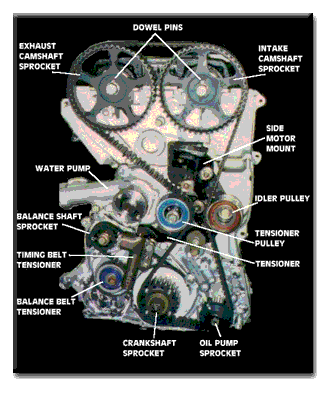
Check your owner’s manual and ask an Auto Care Plus ASE certified technician about the service life of your vehicle’s timing belt. We would be happy to look up the manufacturer’s recommended service schedule on our ALLDATA computer system free of charge. Timing belts should be replaced BEFORE the suggested service life of this critical component ends.

Here are some common intervals by vehicle Manufacturer. There are always exceptions so please check your owner’s manual or call us to confirm. The years are just as important as the mileage, especially in harsh climates like ours here in New England.

Honda and Acura 7 Years or 90,000 and 105,000 miles.

Hyundai and Kia 60,000 miles.

Toyota 90,000 miles.

Frequently Asked Questions

How often does a timing belt need to be replaced?

Most manufacturers specify replacement somewhere between 60,000 and 105,000 miles, or every seven to ten years — whichever comes first. Age matters as much as mileage, because the rubber degrades over time even on a car that sits.

What happens if my timing belt breaks?

On an interference engine — which most modern engines are — the pistons collide with the open valves the instant the belt breaks. That bends valves and can damage pistons and the cylinder head. The repair typically costs more than the vehicle is worth. On a non-interference engine, the car simply stops running and needs to be towed.

Does my car have a timing belt or a timing chain?

It depends entirely on your engine. Chains are generally designed to last the life of the engine, while belts have a hard replacement interval. Tell us your year, make, and model and we will tell you exactly which you have — this is the single most important thing to know about your engine's maintenance.

Why do you replace the water pump with the timing belt?

Because the water pump is usually driven by the timing belt and sits behind the same covers. The pump costs a fraction of the labor to reach it. Replacing them together means you pay that labor once instead of twice — and it means a failing pump cannot destroy your brand-new belt.

Are there any warning signs before a timing belt fails?

Usually not, and that is exactly the problem. A timing belt typically fails without any warning symptom at all. That is why replacement is scheduled by interval rather than by symptom, and why we take the interval seriously.

Is timing belt replacement expensive?

It is a labor-intensive job because of how deeply the belt is buried in the engine. But it is a fraction of what an engine rebuild or replacement costs after a belt failure — and unlike engine failure, it is entirely preventable.

Signs you need this service:

  • Vehicle has reached the manufacturer's timing belt replacement interval
  • Ticking or slapping noise from the front of the engine
  • Engine cranks but will not start
  • Rough running, misfiring, or loss of power
  • Oil leaking from the front of the engine near the timing cover
  • Visible cracking or missing teeth on the belt
  • Engine timing codes stored in the computer
  • You bought a used vehicle and cannot confirm the belt was ever done

Our process:

  • Confirm whether your engine uses a timing belt or a timing chain
  • Look up the manufacturer's replacement interval and review your service records
  • Inspect the belt, tensioner, idler pulleys, and seals where accessible
  • Recommend a complete timing kit rather than a belt alone
  • Remove accessory components and covers to access the timing assembly
  • Set the engine to top dead center and mark all timing references
  • Replace the timing belt, tensioner, idler pulleys, and water pump together
  • Replace front crank and cam seals while access is open
  • Rotate the engine by hand to verify perfect timing alignment
  • Reassemble, start the engine, and verify smooth operation and no leaks

Learn more: