Is your car veering off to the left or the right after setting the steering wheel straight? Did you recently hit a large pothole, or maybe the curb? Have you just purchased new tires? Then it may be time for a wheel alignment!
Alignment Service
Proper alignment is necessary for even tread wear and precise steering. A misaligned vehicle will also affect your gas mileage.
Q. How important is wheel alignment?
A. Research indicates that the average car is driven about 12,000 miles per year. A car with toe alignment just 0.34 degrees (Just 0.17 inches) out of specification has dragged its tires sideways for more than 68 miles by the end of the year!
Q. What are the symptoms of a car that’s out of alignment?
A. Have your car checked if you notice:
- Excessive or uneven tire wear.
- Steering wheel pulls to the left or right. Feeling of looseness or wandering.
- Steering wheel pulls to the left or right.Feeling of looseness or wandering.
- Steering wheel is not centered when car is moving straight ahead.
Many vehicles today are equipped with rear suspensions that can be adjusted for alignment. Our ASE certified alignment technicians can tell you if your vehicle requires a two or four wheel alignment. With our state-of-the-art computerized alignment machines will also provide you with a computer printout showing the adjustments that were made to your vehicle.
The most common adjustable angles are:
Toe
This refers to the tilted direction of the wheels toward or away from one another when viewed from the front. Toe is the most critical tire-wearing angle. Tires that “toe-in” point toward one another. Tires that “toe-out” point away from each other.
Camber
This refers to the tilt of the wheels toward or away from one another when viewed from the top. Wheels that tilt in toward the vehicle have “negative camber.” Wheels that tilt away from the vehicle have “positive camber.”This refers to the tilt of the wheels toward or away from one another when viewed from the top. Wheels that tilt in toward the vehicle have “negative camber.” Wheels that tilt away from the vehicle have “positive camber.”
Caster
This refers to the angle of the steering axis in relation to an imaginary vertical line through the center of the wheel when viewed from the side. “Positive caster” is the term used when the vertical line is tilted back toward the rear. If it’s tilted forward, we call it “negative caster.” The proper caster angle stabilizes your car for better steering.
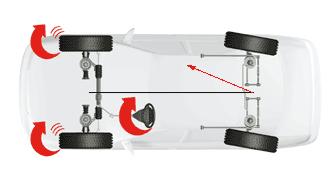
Thrust Angle This refers to the relationship of all four wheels to each other, as well as their relationship to an imaginary centerline that runs from bumper to bumper. The term “thrust line” refers to the direction in which the rear wheels are pointed. Thrust angle is correctable on cars with adjustable rear suspensions. If your car has a non-adjustable suspension, thrust-angle is compensated for by aligning the front wheels to the rear wheels.
Why Four Wheel Alignment?
Reduced Tire Wear
Improper alignment is a major cause of premature tire wear. Over the years, a properly aligned vehicle can add thousands of miles to tire life.
Better Gas Mileage
Gas mileage increases as rolling resistance decreases. Total alignment sets all four wheel parallel which, along with proper inflation, minimizes rolling resistance.
Improved Handling
Does your car pull to one side? Does the steering wheel vibrate? Do you constantly have to move the steering wheel to keep your car traveling straight ahead? Many handling problems can be corrected by total alignment. With all the system components aligned properly, road shock is more efficiently absorbed for a smoother ride.
Front End Inspection
A suspension system inspection is part of our alignment procedure. This allows us to spot worn parts before they cause costly problems.
Wheel alignments should be checked at least once per year or anytime you have your tires replaced. We would be happy to set up an appointment for you to check your wheel alignment. Our Free local courtesy shuttle can take you to work, home or to the local shopping mall! Otherwise, you can always reserve one of our complimentary loaner cars!
Do you perform Free Alignments?
Don’t be fooled by the “Free Alignment” offered by some of those tire installers. Tire installers don’t have the technical knowledge or tools to repair worn steering or suspension components. Therefore, they don’t inspect steering and suspension components for wear or looseness and thus can not make the proper adjustments to the steering angles. If the suspension is worn or not at the correct ride height then any effort to adjust those angles will be for not.